
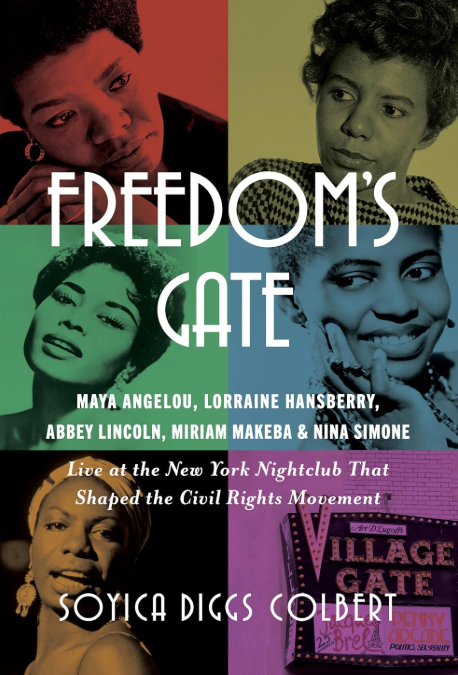
An illuminating portrait of five Black woman artists and the New York nightclub that helped inspire the civil rights movement.
Before they were household names, Maya Angelou, Lorraine Hansberry, Abbey Lincoln, Miriam Makeba, and Nina Simone needed a place to practice and perform. That place was the Village Gate, a New York City nightclub that Art D’Lugoff opened at the dawn of an unprecedented decade in civil rights. In the heart of the West Village, the women of the Gate created something that few could have imagined: a downtown hotspot for Black art, culture, music, and politics.
Freedom’s Gate depicts the groundbreaking artistry and deepening political convictions of the women of the Gate as they developed in the spotlight of art and revolution. From Lorraine Hansberry’s A Raisin in the Sun to Nina Simone’s "Mississippi Goddam" and Abbey Lincoln and Max Roach’s We Insist! Freedom Now Suite, Soyica Diggs Colbert brings to life the culture and performances that were the soundtrack to Black freedom struggles in the 1950s and 1960s. Colbert also shows how the women of the Gate raised money and awareness for groups at the vanguard of civil rights, brought the call for African independence home to New York City, and interwove Western and black diasporic influences into American popular performance, with supporting roles from stars and activists such as Harry Belafonte, Stokely Carmichael, and Sidney Poitier.
As the women relied on one another as entertainers, activists, intellectuals, and friends, the Gate became an outpost for freedom struggles outside of Harlem and the American South, a haven that did not abide by the norms of segregation or the expectations of "women’s work," and a world-renowned venue defined by its radical musicians, artists, and budding stars. Freedom’s Gate is a vibrant history of a little-known chapter of the civil rights movement that gave voice and soul to the call for liberation.
Publisher : W. W. Norton & Company
Publication date : October 13, 2026
Language : English
Print length : 368 pages
ISBN-10 : 1324086645
ISBN-13 : 978-1324086642
Author: Soyica Diggs Colbert
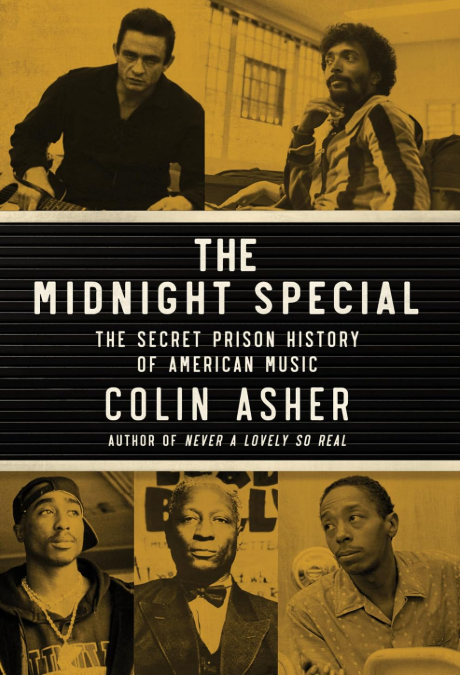
This innovative history explores the rich tradition of music behind bars and shows how policing and prisons have shaped our musical culture from blues to hip-hop.
In American popular music, we often glorify rebellious artists and “outlaws.” But in The Midnight Special, Colin Asher tells a deeper story about the criminal justice system’s impact on our musicians, explored through compelling portraits of five artists whose careers span the twentieth century.
Opening with folk and blues artist Huddie “Lead Belly” Ledbetter, who was made to perform wearing prison clothes, Asher traces the intertwined histories of music and incarceration, from Southern prison farms of the Jim Crow era, through the heroin-driven mid-century drug wars that villainized a generation of jazz artists, and to our present era of mass incarceration.
Asher shows how the suggestion of criminality has often benefited white artists, while prosecutions often hurt Black musicians. Comparing the divergent trajectories of jazz pianist Elmo Hope with country singer Johnny Cash, Asher examines how violent and discriminatory policing stifled Hope’s career and led to the creation of his album Sounds from Rikers Island (1963), while forgiveness and lenience brought us Cash’s masterpiece At San Quentin (1969).
With keen musical analysis and sociological insight, The Midnight Special examines key themes in culture and criminal justice, from the movement for prison reform that allowed soul musician Ike White to stage thrilling concerts while locked up and record his album Changin’ Times (1977), to the crushing cultural weight of mass incarceration a generation later. Closing with Tupac Shakur’s Me Against the World (1995) and stories of music in prisons today, The Midnight Special recounts how prisons occasionally incubate talent but more often shorten careers and distort the public’s perception of musicians and their value to society.
An urgent book about the ways music can affirm an individual’s sense of humanity in dehumanizing circumstances, The Midnight Special writes the history of prisons into American music―a story as important as it is overlooked.
Publisher : W. W. Norton & Company
Publication date : June 30, 2026
Language : English
Print length : 336 pages
ISBN-10 : 1324051396
ISBN-13 : 978-1324051398
Author: Colin Asher
"This book, I suspect, will detonate over certain corners in America.... Darkology is a major and thrilling work of American history." ―Dwight Garner, New York Times Book Review
As Heard on NPR's Fresh Air: "Quite enlightening." ―Terry Gross
"Tremendous.... Barnes has corralled the chaos, contradiction, and surprise of American social reality; evaded mythology; and made... the ‘unwritten’ legible.... [A] painfully necessary autopsy of the nation’s soul." ―Walton Muyumba, Boston Globe
Named one of the Best Books of the Month by the New York Times, TIME, and Kirkus Reviews
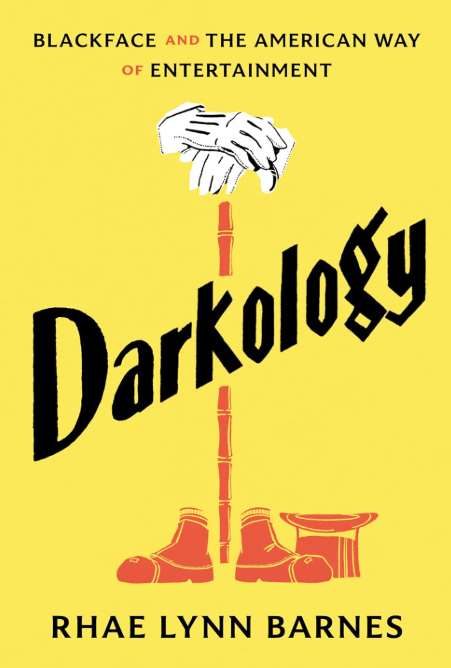
A groundbreaking history, decades in the making, that chronicles how blackface dominated American society culturally, financially, and racially for nearly two centuries.
Never before has the disturbing story of blackface and its piercing reflection of American society been so comprehensively told. With Darkology, Princeton historian Rhae Lynn Barnes meticulously unravels the complex, subterranean, and all-too-often expunged history of “Darkology”―the insidious study, commodification, and dehumanization of Black life, through which performers caricatured the enslaved and formerly enslaved for their supposed subservience and happy demeanor.
Given the extraordinary research reflected inDarkology, it’s not surprising that Barnes spent twenty years tracking down “fading photographs, old movies, bureaucratic detritus, moldy scripts, and living witnesses, assembling an impressive archive that allowed her to demonstrate the astonishingly broad reach of blackface minstrelsy” (Laurel Thatcher Ulrich). Painstakingly piecing together these scattered shards of evidence, Barnes reveals the shocking extent to which blackface took center stage in every era of American history.
This was not a fringe activity. By 1830, as political resistance to slavery grew, blackface exploded from a niche performance into a venomous national export. Within a decade, hardly a theater in the countrydidn’tput on minstrel shows. Following the Civil War, this grotesque entertainment soared, seeping from professional theaters into everyday amateur shows, print, and advertisements. It was everywhere: Elks Clubs, religious institutions, battlefields, universities, and schools. It wasn’t justinthe Jim Crow era; itdefinedit. The very name “Jim Crow” derives from minstrelsy’s founding character.
Darkologydismantles the myth that blackface was a fleeting, post–Civil War phenomenon. Even in eras known for liberal progressivism, it flourished. Barnes unearths the startling fact that four-term president Franklin D. Roosevelt was a devotee who died hours before a blackface show he had commissioned at Warm Springs. It permeated U.S. military bases and was even used in World War II Japanese American concentration camps and German POW camps as a bizarre tool of “Americanization.”
After WWII, the tide began to turn as Black veterans and mothers in places like suburban California protested the practice in schools. Still, blackface performances proved resilient, surfacing as late as 1969 at the University of Vermont. Even as the Civil Rights movement fought for equality, blackface remained present in American politics and white supremacist organizing through the Nixon and Ford administrations, its legacy still percolating in variable forms today.
By tracing minstrelsy’s evolution through oral histories, material culture, and a wide range of multimedia sources, Barnes’s “masterpiece” (David Blight) forces us to reckon with the myriad ways the American Dream wore blackface. Recasting this American story with “vivid and engaging storytelling” (Howard French),Darkologyis a landmark work that peers beneath the boulders deliberately obscuring our past―illuminating a path toward a more just and equal society in America’s future. 72 illustrations
Publisher : Liveright
Publication date : March 24, 2026
Author: Rhae Lynn Barnes
Language : English
Print length : 528 pages
ISBN-10 : 1631496344
ISBN-13 : 978-1631496349
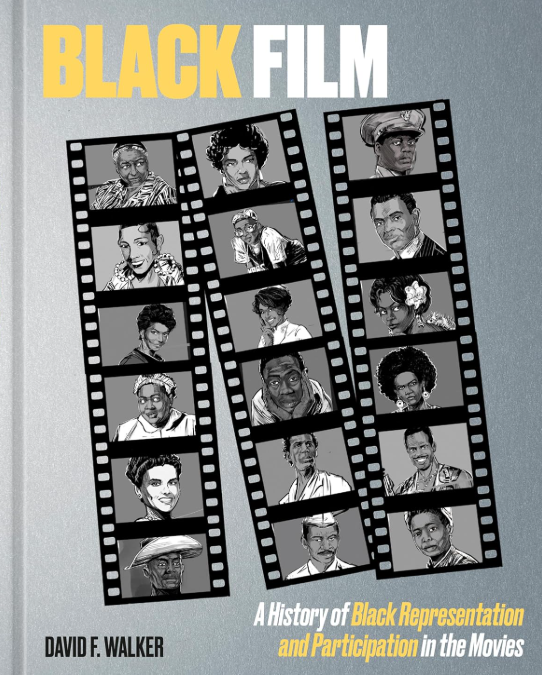
An illustrated history that celebrates the legacy of Black actors, films, and filmmakers from the silent era through today and explores the deeply embedded racism of the film industry, from the award-winning author of The Black Panther Party
In Black Film, Eisner Award-winning author David F. Walker presents an immersive dive into the crucial history of Black actors, films, and filmmakers. Following closely behind the very first moving picture captured by Eadward Muybridge in 1872, Thomas Edison's thirty-second "actualities" from the late 1890s, including A Watermelon Contest and Dancing Darkey Boy, are among the first short films to depict Black people. These can be considered the earliest examples of how the film industry would go on to exploit, appropriate, and shape the narrative of Black people for the duration of its development.
Divided by decade, each section of the book covers an important era and milestone for Black film, highlighting both difficulties and triumphs through time. For example:
The harmful popularization of blackface and minstrel shows (1890-1914)
The emergence of racist feature-length movies such as Birth of a Nation after the advancement of sound in film, countered by the success of pioneering Black filmmakers such as Oscar Michaeux and brothers George and Noble Johnson (1915-1928)
The rise of trailblazing actors such as Sidney Poitier and Dorothy Dandridge (1950-1959)
The roots of Blaxploitation as a subgenre and how Black people ultimately saved Hollywood during trying times (1970-1979)
The exciting crossover of hip-hop music into film (1980-1989)
The box office success of Marvel's The Black Panther, Moonlight's history-making Best Picture win, and more.
With gorgeous illustrations, film stills, and rare pieces of ephemera, Black Film celebrates the glowing contributions of Black actors and filmmakers, without shying away from discussing the racism that is rooted in Hollywood—an important reality to address in order to make progress.
Publisher : Ten Speed Press
Publication date : March 24, 2026
Author: David F. Walker
Language : English
Print length : 208 pages
ISBN-10 : 198486016X
ISBN-13 : 978-1984860163
No results match your search. Try removing a few filters.